

Grain markets ended the day on a clearly positive note, with wheat, maize and rapeseed all closing higher. The main driver remained the combination of actual physical demand, weather risk and concerns surrounding the new crop.
The strongest movement came in rapeseed, where the May contract jumped sharply to €667.25/tonne, while movements in the new crop remained considerably more moderate. Wheat continued to find support from deteriorating conditions in the US, Saudi Arabia’s large purchase and weaker expectations for the Russian harvest.
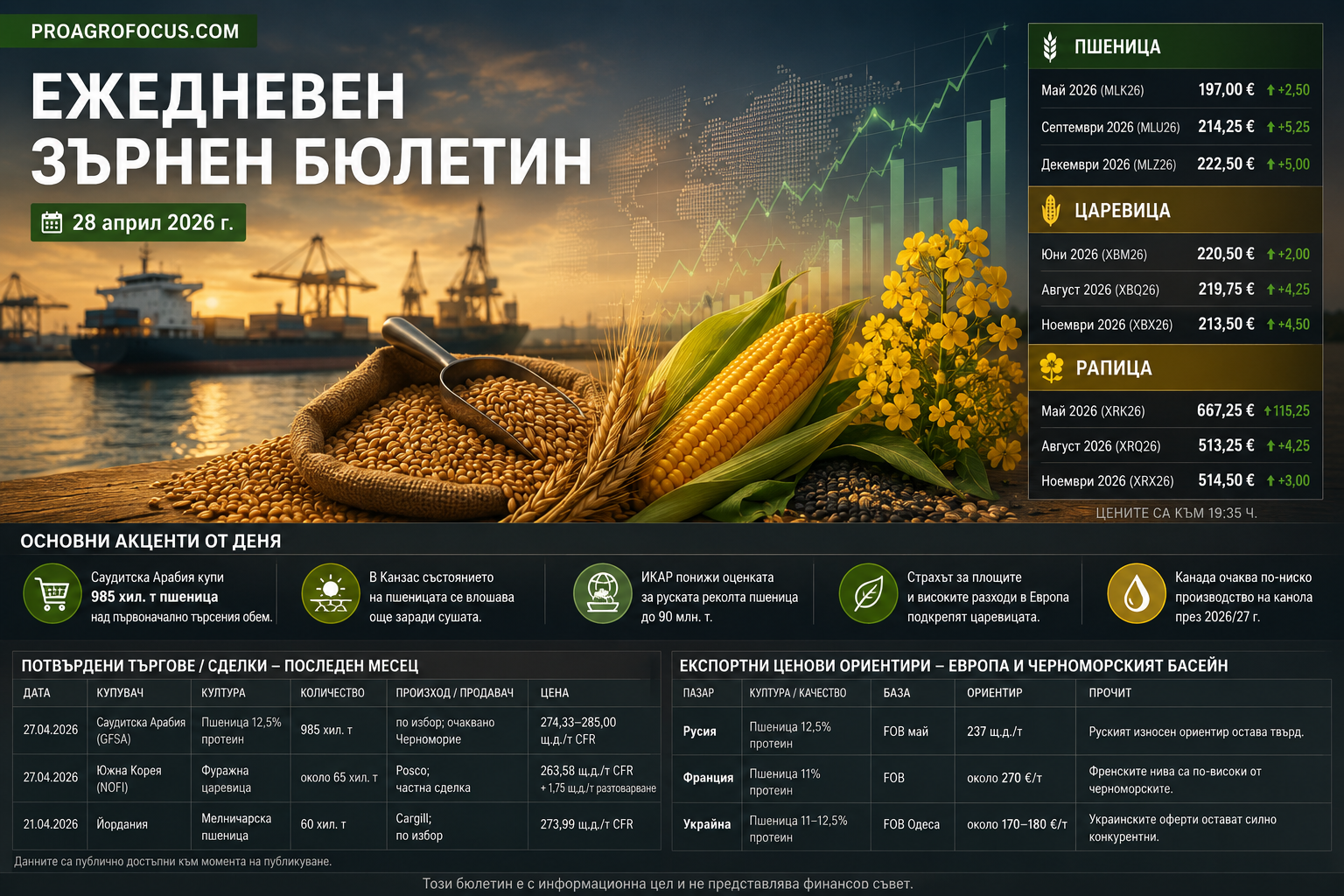
Grain bulletin dated 28 April 2026
The following tables and highlights transcribe the historical grain bulletin dated 28 April 2026. These data are not current offers.
PROAGROFOCUS.COM
Wheat, maize and rapeseed prices
Scroll the table horizontally to view all columns.
| Crop | Month and code | Price | Change |
|---|---|---|---|
| Wheat | May 2026 (MLK26) | 197,00 € | Increase: +2,50 |
| Wheat | September 2026 (MLU26) | 214,25 € | Increase: +5,25 |
| Wheat | December 2026 (MLZ26) | 222,50 € | Increase: +5,00 |
| Maize | June 2026 (XBM26) | 220,50 € | Increase: +2,00 |
| Maize | August 2026 (XBQ26) | 219,75 € | Increase: +4,25 |
| Maize | November 2026 (XBX26) | 213,50 € | Increase: +4,50 |
| Rapeseed | May 2026 (XRK26) | 667,25 € | Increase: 115,25 |
| Rapeseed | August 2026 (XRQ26) | 513,25 € | Increase: +4,25 |
| Rapeseed | November 2026 (XRX26) | 514,50 € | Increase: +3,00 |
The artwork quotes prices in euros without explicitly stating a per tonne unit. It does not state the period for the displayed changes.
Key highlights of the day
- Saudi Arabia bought 985 thousand tonnes of wheat, above the volume initially sought.
- Wheat conditions in Kansas are deteriorating further because of drought.
- IKAR lowered its estimate for the Russian wheat harvest to 90 million tonnes.
- Concerns about planted areas and high costs in Europe support maize.
- Canada expects lower canola production in 2026/27.
Confirmed tenders / transactions
Scroll the table horizontally to view all columns.
| Date | Buyer | Crop | Quantity | Origin / seller | Price |
|---|---|---|---|---|---|
| 27.04.2026 | Saudi Arabia (GFSA) | Wheat, 12,5% protein | 985 thousand tonnes | Optional origin; expected Black Sea | 274,33 to 285,00 US$/t CFR |
| 27.04.2026 | South Korea (NOFI) | Feed maize | Around 65 thousand tonnes | Posco; private transaction | 263,58 US$/t CFR + 1,75 US$/t unloading |
| 21.04.2026 | Jordan | Milling wheat | 60 thousand tonnes | Cargill; optional origin | 273,99 US$/t CFR |
Export price benchmarks
Scroll the table horizontally to view all columns.
| Market | Crop / quality | Basis | Benchmark | Interpretation |
|---|---|---|---|---|
| Russia | Wheat, 12,5% protein | FOB May | 237 US$/t | The Russian export benchmark remains firm. |
| France | Wheat, 11% protein | FOB | Around 270 €/t | Offer levels are higher than those in the Black Sea region. |
| Ukraine | Wheat, 11 to 12,5% protein | FOB Odesa | Around 170 to 180 €/t | Ukrainian offers remain highly competitive. |
US$/t means US dollars per tonne. €/t means euros per tonne. Decimal commas follow the original artwork.
The data are publicly available at the time of publication.
This bulletin is for information only and does not constitute financial advice.
Wheat: the market is now looking beyond drought
Wheat was among the strongest crops of the day:
- May 2026 closed at €197.00
- September 2026 reached €214.25
- December 2026 ended at €222.50
This movement shows that the market is beginning to price in both immediate risks and potential problems with the new crop.
One of the strongest factors of the day was Saudi Arabia’s large purchase. The state agency GFSA bought 985 thousand tonnes of wheat, significantly more than the 710 thousand tonnes initially sought. This is an important signal because it confirms the presence of actual physical demand, rather than purely speculative movements on the exchanges.
Additional support also came from the US, where the condition of winter wheat in Kansas continues to deteriorate. Only 23% of crops are rated good to excellent, while 41% remain in poor to very poor condition.
The market is gradually beginning to accept that the risk to wheat with a high protein content may be real rather than temporary.
Russia remains the key factor for the Black Sea region
One of the most important developments for the region came from Russia, where IKAR lowered its forecast for the 2026 wheat harvest to 90 million tonnes.
Although the change may seem small, the market reacted strongly because:
- export prices remain firm;
- spring fieldwork is behind schedule;
- some areas in Central Russia and the Volga region are facing difficulties.
For Bulgarian producers, Russian FOB levels remain the main benchmark for the market in the Black Sea region. If pressure from the Russian harvest eases, European and Bulgarian wheat could find it easier to maintain higher price levels.
Maize finds support in Europe
Maize also ended the day firmly higher:
- June 2026: €220.50
- August 2026: €219.75
- November 2026: €213.50
Interestingly, this time support is coming from more than just the US or Brazil. High input costs and concerns over the area planted in Europe are becoming increasingly significant factors.
Expensive fertilisers and weak margins are beginning to have a tangible effect on spring sowing decisions. The market is now pricing in the risk that some producers may reduce their planted area or fertiliser application rates, which would automatically make the new crop more sensitive to drought and adverse weather.
Rapeseed remained the most volatile market
The strongest movement of the day was undoubtedly in rapeseed.
The May contract jumped sharply to €667.25, but the new crop remained much calmer:
- August 2026: €513.25
- November 2026: €514.50
This clearly shows that the market distinguishes between pressure on nearby deliveries and a more realistic assessment of the new season.
Additional support came from Canada, where canola production is expected to fall to 20.11 million tonnes in 2026/27. Strong domestic demand for processing and oilseed products is also keeping the market steady.
What does this mean for Bulgarian producers?
Today’s trading session mattered both because of the green figures on the screen and because it showed a change in the way the market is behaving.
In wheat, the movement is now supported by actual international demand as well as concerns about the weather.
In maize, Europe is beginning to become a factor in prices rather than simply an observer.
In rapeseed, the market remains highly sensitive to any change in the global oilseed supply and demand balance.
For Bulgarian producers, the most important questions in the coming days will be:
- whether there will be new international tenders;
- whether Russian forecasts continue to be lowered;
- whether drought in the US worsens;
- whether European concerns over the area planted turn into a real problem.
Market conditions remain supportive, but also extremely sensitive to any new information from the Black Sea region, the US and the Middle East.


